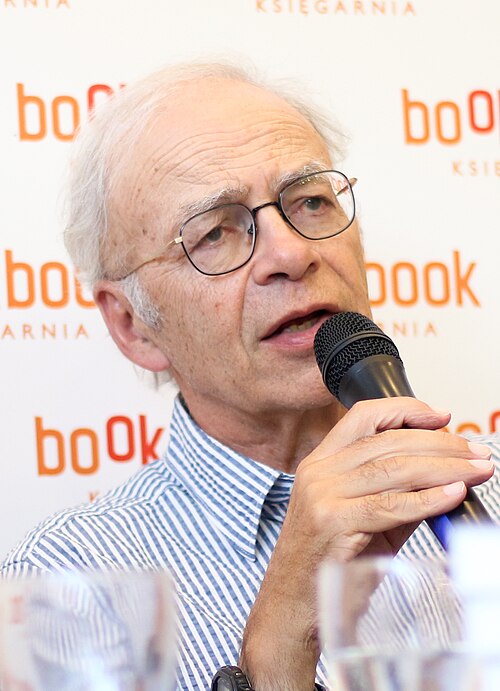
Philosophical founder
Peter Singer
b. 1946Utilitarian philosopher whose drowning-child argument and 2013 TED talk supplied EA's founding premise — and its irresistible sales pitch.
Wikipedia →Charity reduced to a branch of economics.
A movement that promises to use evidence and reason to do the most good per dollar — and that, its critics argue, became a recruiting funnel for AI doomerism, a moral shield for fraud, and a way to turn ethics into math that always seems to favor the people doing the calculating.
Effective Altruism (EA) began with an unimpeachable premise: if you can prevent suffering at little cost, you are obligated to do so. From that seed grew charity evaluators, “earn to give” career advice, and billions in directed giving. But EA emerged from the rationalist community and birthed longtermism, and over a decade it drifted from malaria nets to speculative AI risk. Its biggest donor, Sam Bankman-Fried, committed one of history's largest frauds in its name. Critics call it top-down colonial philanthropy, “misogyny encoded into math,” and a framework whose utilitarian logic can justify almost anything.
Effective Altruism starts from a thought experiment by the philosopher Peter Singer: if you walked past a child drowning in a shallow pond, you would be obligated to wade in and save them, even at the cost of ruined clothes. Singer argues that distance makes no moral difference — a child dying of a preventable disease overseas has the same claim on you as the one in front of you.
From that premise EA draws a radical conclusion: those with means are obligated to give, and to give effectively — directing money where it buys the most measurable good. Who could argue with that? The pitch is almost impossible to refuse, which is precisely what makes the movement built on top of it so hard to criticize from the outside.
EA's defining move is to make doing good quantifiable. Lives are converted into units — dollars per life saved, quality-adjusted life-years — and causes are ranked by cost-effectiveness. Career choices become optimization problems: the “earn to give” doctrine tells bright young people to take the highest-paying job they can, even a morally dubious one, and donate the proceeds.
Critics argue this reduces all of ethics to a branch of economics, discarding justice, dignity, liberation, community, and democratic participation as things that cannot be measured. The scholar Émile P. Torres — a former insider — describes a framework in which, on the underlying utilitarian view, “there's nothing intrinsically wrong about any act. Not murder, not fraud, not lying or cheating.”
EA emerged from the rationalist community around LessWrong, and that lineage pulled it steadily away from present suffering. Saving lives now is good — but if future people count equally, and there could be 10²⁴ of them, then reducing a tiny probability of human extinction outscores any malaria program. This is the logic of longtermism, EA's most influential offspring.
By the 2020s the movement's flagship career advice listed AI risk above global poverty, and climate change barely registered. The same expected-value math that began with mosquito nets now justified pouring resources into speculative machine-superintelligence scenarios — and, for a while, into the fortune of a crypto billionaire who said all the right words.
The doctrines that recur across the movement's founders, theorists, and builders.
Every life counts equally regardless of distance, nationality, or relationship to you. The goal is to maximize total well-being — and partiality toward your own community is a bias to be corrected.
It is not enough to do good; you must do the most good possible. A charity that saves ten lives per dollar is morally superior to one that saves one, and choosing the latter is treated as a failure.
For many, the highest-impact career is a lucrative one donated to good causes. Take the Wall Street or quant-trading job and give the money away — the ends justify the means of acquiring it.
Causes are ranked by scale, neglectedness, and tractability. Resources should flow to whichever cause this calculation favors — even if that means abandoning the cause closest to your heart.
Decisions are made by multiplying outcomes by their probabilities. A tiny chance of an astronomically large payoff can outweigh a certainty of helping people now — the move that carries EA from charity to longtermism.
Sentiment and tradition are distrusted; randomized trials, metrics, and explicit calculation are trusted. What cannot be measured — justice, dignity, solidarity — tends to fall out of the ledger entirely.
The specialized terms you need to read the movement in its own words.
Founders, theorists, builders, and financiers of the project.
Utilitarian philosopher whose drowning-child argument and 2013 TED talk supplied EA's founding premise — and its irresistible sales pitch.
Wikipedia →
Co-founded EA and longtermism; author of “Doing Good Better” and “What We Owe the Future.” Pitched SBF on “earn to give” and defended him on Sam Harris's podcast after the collapse.
Wikipedia →
EA's biggest funder. Radicalized by MacAskill ~2012; Jane Street → Centre for EA → FTX → an ~$8B fraud justified, critics say, by utilitarian logic. Convicted on seven counts in 2023.
Wikipedia →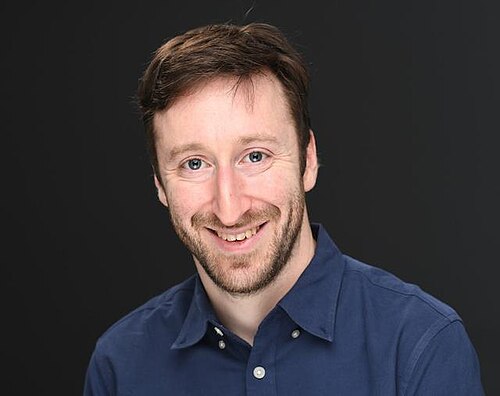
Co-founded GiveWell and later Open Philanthropy, steering hundreds of millions in EA money — increasingly toward AI risk.
Wikipedia →
Co-founded GiveWell with Karnofsky, building the cost-effectiveness machinery that defines EA's measurable, metrics-first approach to charity.
Wikipedia →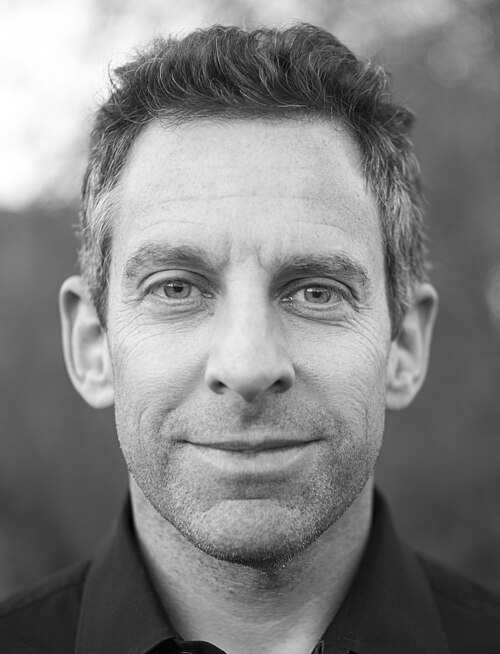
Podcaster aligned with EA and rationalism; hosted MacAskill, including the appearance where MacAskill defended SBF after FTX collapsed.
Wikipedia →
Former community member who described EA's culture as “misogyny encoded into math,” one of many accounts feeding the movement's 2023 reckoning.

Co-author (with Luke Kemp) of “Democratising Risk,” a critique of EA's centralized, techno-utopian approach; says she was “railroaded” over fears of offending donors like Open Philanthropy.
The essays, declarations, and books that built the doctrine.
The essay that supplied EA's moral core: if we can prevent suffering without sacrificing anything comparably important, we are obligated to do so.
Read ↗The book that brought EA to a mass audience — earn-to-give, cost-effectiveness, and the case for ruthless prioritization.
Read ↗The longtermist manifesto arguing future people matter as much as the living — published months before FTX collapsed. Musk called it “a close match for my philosophy.”
Read ↗The cost-effectiveness machinery in practice: ranked “top charities” by dollars per life saved — and, critics note, almost entirely Western-run.
Read ↗EA's career guide. Over time its highest-impact recommendations came to be dominated by AI risk, with climate change conspicuously absent.
Read ↗The pledge that organized the movement: a public commitment to give at least 10% of income to the most effective causes.
Read ↗If it is in our power to prevent something bad from happening, without thereby sacrificing anything of comparable moral importance, we ought, morally, to do it.— Peter Singer, “Famine, Affluence, and Morality” (1972)
Effective altruism is misogyny encoded into math.— Sonia Joseph
He was basically a utilitarian and a longtermist… on the utilitarian view, there's nothing intrinsically wrong about any act. Not murder, not fraud, not lying or cheating.— Émile P. Torres, on Sam Bankman-Fried
EA likes the criticism that it likes… but if you criticize key aspects upon which the framework is based, you will be ostracized, attacked, and maybe even threatened with violence.— Émile P. Torres (paraphrased)
Effective Altruism markets itself as the rational, evidence-based way to do good. Its critics — many of them former insiders — argue that beneath the spreadsheets sits an elite ideology that launders power: it concentrates decision-making in Western hands, manufactures a moral shield for the wealthy, and, taken to its logical end, produced Sam Bankman-Fried.
EA moves money from the Global North to the Global South while keeping control in the North. GiveWell's recommended organizations are overwhelmingly Western; the Ugandan farmer Anthony Kula called EA worse than traditional philanthropy for imposing “predetermined solutions not rooted in the lived experiences of the extreme poor.”
Sam Bankman-Fried did exactly what the doctrine prescribed — get filthy rich to give it away — and committed an ~$8B fraud doing it. Émile Torres argues the underlying utilitarianism makes no act, “not murder, not fraud,” intrinsically wrong. MacAskill, who recruited him, defended him on Sam Harris's show.
When Carla Cremer and Luke Kemp published a critique, they say they were “railroaded” over fears of offending donors like Open Philanthropy. A 2023 Time investigation reported misconduct accounts from seven women; Sonia Joseph called the culture “misogyny encoded into math.”
Expected-value math carried EA from malaria nets to speculative AI risk: if 10²⁴ future people might exist, the living become a rounding error. Longtermism, EA's offspring, even reframes habitat destruction and climate damage as acceptable — the present sacrificed to a hypothetical future.
Transhumanism does not stand alone. It feeds — and is fed by — the other letters of TESCREAL.
People, organizations, and the ideologies this one bleeds into. Drag nodes, hover to isolate, scroll to zoom — or pop it out fullscreen.
Primary documents and reporting used on this page. See the full References library → for the complete source list.