Doom prophet
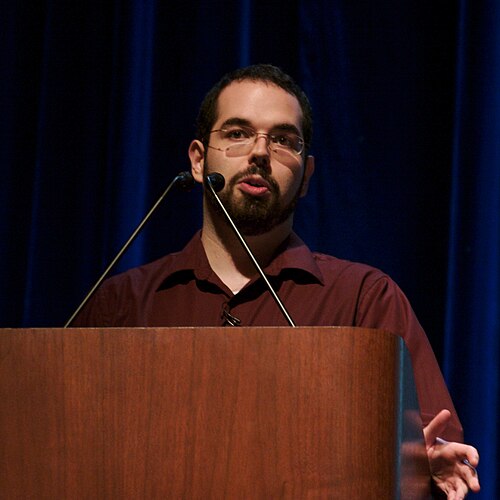
Eliezer Yudkowsky
b. 1979Founded the Singularity Institute / MIRI and the rationalist community. Argues misaligned superintelligence is the default road to extinction; co-author of “If Anyone Builds It, Everyone Dies.”
Wikipedia →Building God, on a deadline.
The belief that machine intelligence will soon surpass our own and trigger a runaway “intelligence explosion” — the Singularity — after which human history as we know it ends. The third letter of TESCREAL, and the one that turns the bundle into an engineering project.
Singularitarianism takes transhumanism's promise of transcendence and names the mechanism: a self-improving artificial intelligence that, once smarter than us, redesigns itself again and again until it leaves humanity behind in a matter of months or hours. For its prophets the Singularity is a technological Rapture to be welcomed and accelerated; for its doomsayers it is an extinction event to be prevented at any cost. Either way it casts a small priesthood of insiders as the people who decide the fate of all future life — and both wings, critics note, agree the stakes are infinite.
The Singularity is borrowed from physics: the point at a black hole's center where the known laws break down and prediction becomes impossible. Applied to technology, it names the moment when machine intelligence exceeds human intelligence and begins improving itself faster than we can follow. Beyond that horizon, Singularitarians argue, the future is literally unknowable, because it will be shaped by minds we cannot comprehend.
The mechanism is recursive self-improvement. A machine smart enough to do AI research can build a smarter machine, which builds a smarter one still — a feedback loop that, once it starts, runs away from human control. The mathematician I. J. Good called the result an “intelligence explosion,” and observed that the first ultraintelligent machine would be “the last invention that man need ever make.”
The concept was formalized in 1993 by mathematician and novelist Vernor Vinge in a paper delivered at a NASA symposium: “Within thirty years, we will have the technological means to create superhuman intelligence. Shortly after, the human era will be ended.” But it was Ray Kurzweil who turned a hypothesis into a worldview — and into something openly theological.
In The Singularity Is Near (2005) Kurzweil dated the event to 2045 and described it in the language of religion. Asked whether there is a God, he answered: “Not yet, but there will be.” Academics have catalogued the parallels: the scholar Egil Asprem reads Kurzweil's Singularitarianism as “contemporary esotericism,” a millenarian faith with the Singularity as its Rapture, mind-uploading as resurrection, and The Singularity Is Near as its scripture. Critics inside the movement nicknamed it “the Rapture for the nerds.”
Not every believer is celebrating. Where Kurzweil sees salvation, Eliezer Yudkowsky sees the default outcome as human extinction. His thesis: superintelligence is coming, almost every way of building it kills everyone, and the people who understand this carry a moral obligation to solve “alignment” above all else. To that end he founded the Singularity Institute — later MIRI — and spawned the rationalist community as a recruiting and training ground for the problem.
The two wings disagree about the ending but share the premise, and that premise is what critics find most consequential: that a tiny group of insiders in a handful of labs is steering an event of cosmic, infinite stakes. By 2025 Yudkowsky and Nate Soares were arguing the case in a trade book titled, without hedging, If Anyone Builds It, Everyone Dies — while the labs the movement helped seed, DeepMind and OpenAI, raced to build the very thing it warned about.
The doctrines that recur across the movement's founders, theorists, and builders.
Everything else — wealth, health, power, survival — flows downstream of intelligence. Whoever builds the smartest system controls the future.
An AI able to improve itself enters a feedback loop. Each gain accelerates the next, so progress goes from gradual to explosive — fast enough to escape human oversight.
After superintelligence arrives, prediction breaks down. Today's institutions, economics, and politics become irrelevant overnight. There is a clean break with all prior history.
Exponential trends in computing make it a question of when, not if. Kurzweil's “Law of Accelerating Returns” treats the date as something you can read off a graph.
Getting the Singularity right (or wrong) outweighs every other human concern. This justifies treating AI as a near-religious priority — and its builders as people of world-historic responsibility.
Because the stakes are infinite and the public doesn't understand, an enlightened minority — researchers, founders, funders — has both the right and the duty to decide how it unfolds.
The specialized terms you need to read the movement in its own words.
Founders, theorists, builders, and financiers of the project.
Founded the Singularity Institute / MIRI and the rationalist community. Argues misaligned superintelligence is the default road to extinction; co-author of “If Anyone Builds It, Everyone Dies.”
Wikipedia →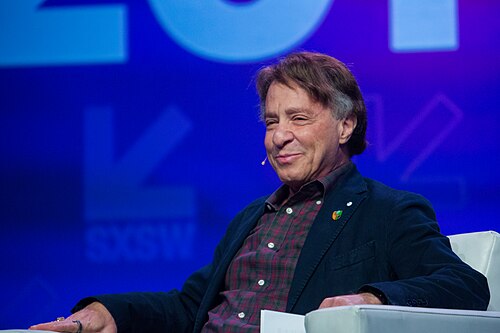
Turned the Singularity into a worldview and dated it to 2045. “Not yet, but there will be [a God].” Co-founded Singularity University with Larry Page.
Wikipedia →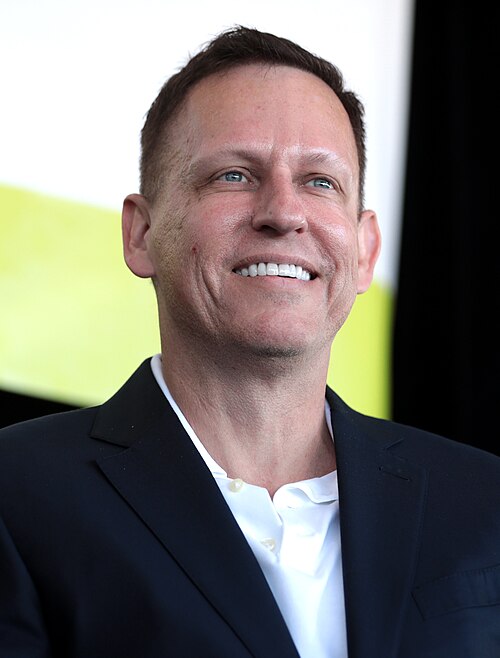
Funded the Singularity Institute and the Stanford Singularity Summits, and was an early backer of DeepMind. The movement's most consequential financier.
Wikipedia →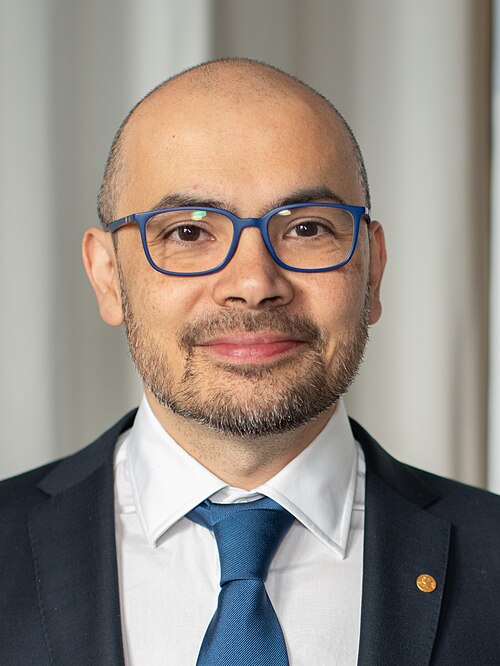
Co-founded DeepMind to “solve intelligence,” framing AGI as a Manhattan-Project-scale effort. Now leads Google's AI; shared the 2024 Nobel Prize in Chemistry.
Wikipedia →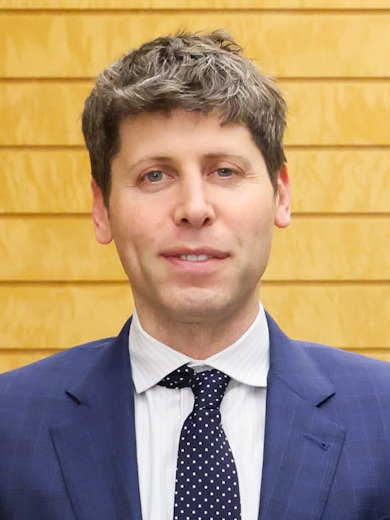
OpenAI CEO; credits Yudkowsky as a critical influence on the field. Describes AGI as “magic intelligence in the sky” — the Singularity recast as product roadmap.
Wikipedia →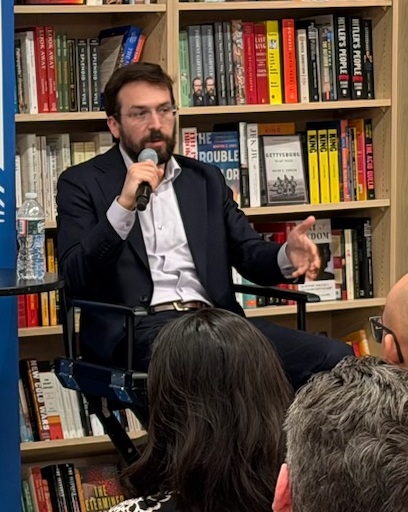
President of MIRI and co-author with Yudkowsky of “If Anyone Builds It, Everyone Dies” (2025) — the doom wing's argument made into a mass-market warning.
Wikipedia →The essays, declarations, and books that built the doctrine.
The founding text, delivered at a NASA symposium. “Within thirty years… Shortly after, the human era will be ended.”
Read ↗The essay that supplied the math: exponential, not linear, progress — making the Singularity, in Kurzweil's telling, inevitable.
Read ↗The movement's scripture. Dates the Singularity to 2045 and describes it in openly theological terms.
Read ↗MIRI technical report arguing that recursive self-improvement could produce a fast, decisive takeoff — the case for hard FOOM.
Read ↗The academic statement of takeoff and the control problem that pulled Musk, Altman, and policymakers into the alignment debate.
Read ↗The doom wing's mass-market case: building superintelligence with today's methods means human extinction.
Read ↗Within thirty years, we will have the technological means to create superhuman intelligence. Shortly after, the human era will be ended.— Vernor Vinge, 1993
Is there a God? Not yet, but there will be.— Ray Kurzweil
The first ultraintelligent machine is the last invention that man need ever make.— I. J. Good, 1965
If anyone builds it, everyone dies.— Eliezer Yudkowsky & Nate Soares, 2025
Singularitarianism presents itself as hard-nosed forecasting — just extrapolating the curves. Critics argue it is eschatology in a lab coat: a faith whose central event is always about twenty years away, whose failures to arrive are explained as delays, and whose true function is to hand a small priesthood of technologists authority over everyone else's future.
The structure maps exactly onto apocalyptic Christianity — Rapture, resurrection, original sin, a saved remnant. Scholars like Egil Asprem classify Kurzweil's version as millenarian “contemporary esotericism,” not science.
The date keeps moving — 2020, 2029, 2045 — and every miss is reframed as “not yet.” A claim that can never be wrong is not a prediction; it's an article of faith.
Whether the AI saves us or kills us, both wings agree it is the most important thing in history and that insiders must steer it. The framing concentrates power and capital in the very labs racing to build it.
If the Singularity is cosmic salvation or extinction, then present human concerns — jobs, rights, the eight billion alive now — shrink to a rounding error against an imagined future. That math has been used to excuse almost anything.
Transhumanism does not stand alone. It feeds — and is fed by — the other letters of TESCREAL.
People, organizations, and the ideologies this one bleeds into. Drag nodes, hover to isolate, scroll to zoom — or pop it out fullscreen.
Primary documents and reporting used on this page. See the full References library → for the complete source list.